
What Your Feedback Built: A Year of the Client Advisory Board
Here's what usually happens when you give software feedback.
You raise it with support. Someone thanks you and says they'll pass it on. And that's the last you hear of it. No confirmation it reached anyone, no decision either way, nothing.
We started our Client Advisory Board in January 2026 to close that gap. This post is the accounting.
The loop we're trying to run
The idea is simple, and it only works if all three parts happen.
Input. Members tell us what's actually slowing them down. Not feature requests dressed up as strategy — the real friction.
Build. We prioritise from that, alongside the regulatory work we can't avoid.
Report back. We come back the next quarter and show what shipped. Including the things we didn't get to.
That last part is where most feedback programmes quietly fall over. So here's ours.
Six things that shipped
1. Push notifications on mobile
This one came out of a finding we didn't love hearing.
In our first session, members told us support workers rarely check email. Managers had worked around it — WhatsApp groups for shift changes, SMS for anything urgent. Coordination was happening outside the system entirely, which means it wasn't on the record.
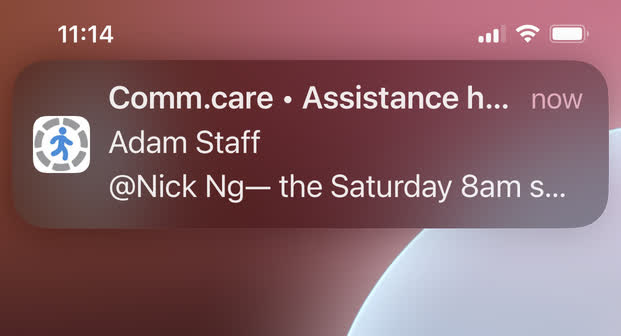
Comm.care now sends real-time push notifications on iOS and Android. @mentions, flagged documents, and vacant shift alerts land on the phone the worker already has in their pocket.
The vacant shift case is the one members raised most. Instead of messaging four people individually and waiting, you @mention the team and the alert goes out at once. Here's how that works in practice.
2. Multiple funding periods on a roadmap
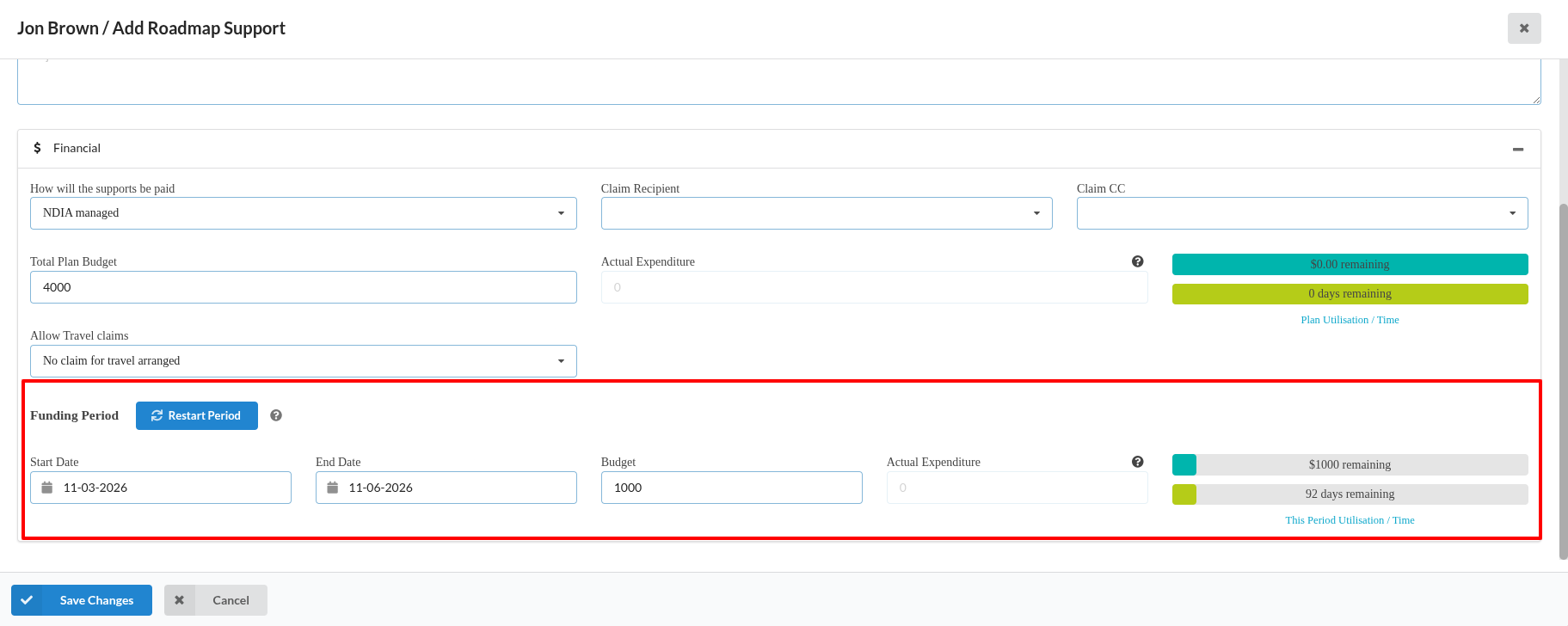
An NDIS plan's budget isn't flat across its life. Funding is released in periods, and a participant's position in period three tells you nothing useful if you're only tracking the annual total.
A support coordinator raised this as a genuinely confusing question: were they supposed to create twelve roadmaps for twelve funding periods?
No. And now they don't have to. A roadmap can hold multiple consecutive funding periods, each individually budgeted, with expenditure tracked against the period that's actually running. More detail here.
3. A warning when someone's over-rostered
Coordinators were finding out about over-rostering after the fact — usually when the payroll numbers came back.
The schedule now warns you when a staff member goes past 38 hours in a week. You see it while you're building the roster, not once the shift is confirmed and worked.
4. Sortable, searchable lists
Small one. Worth naming anyway.
A member told us they were scrolling an unsorted dropdown hunting for a support worker's name every time they assigned a shift. Dozens of times a day.
Dropdowns now sort alphabetically and support search. Type a few letters and you're there.
We include this deliberately. Not every piece of feedback becomes a major feature, and a board that only ever produces headline items isn't listening properly.
5. Clock-in and clock-out fixes
Raised repeatedly, by more than one member, which is usually the sign that something is properly broken rather than a one-off.
We worked through the reliability and usability problems on mobile. Clocking is the kind of thing that has to be boring and dependable, because a support worker in someone's home has better things to do than fight a button.
6. My Aged Care IDs for CHSP
Less exciting, harder to skip.
MAC ID is now recorded as a mandatory field, in place ahead of the 30 June DEX deadline. CHSP providers on the board flagged the timing early enough that this landed with room to spare rather than as a scramble.
What we're building now
Three things are underway. We'll show members progress before we show anyone else, and we're not going to put dates on them here.
A new Service Agreement → Budget → Service model. This replaces the single roadmap. A participant can hold multiple budget envelopes — NDIS Core, Capacity Building and Capital, or the Support at Home funding streams — each tracking its own spend. It's the foundation the next two items depend on.
Support at Home associated-provider billing. Multiple line items per service, so providers can bill correctly under the new programme structure.
SIL under the new Practice Standards. Tailoring Comm.care so SIL providers can manage those obligations in the platform rather than alongside it.
The board is deliberately small
Between 8 and 12 seats. That's the whole thing.
We keep it that way on purpose. A 60-minute session with a dozen providers is a conversation where everyone gets heard. The same session with sixty people is a webinar, and nobody says anything honest in a webinar.
The trade-off is that we can't take everyone. If you're using Comm.care day to day, think about your operations beyond this week's roster, and are willing to tell us when something we've built doesn't work — that's the profile.
Four sessions a year, 60 minutes each, online. No cost, no sales pitch, no obligation to say nice things.
How to apply
We open seats a handful at a time, usually ahead of a quarterly session.
Apply for the Client Advisory Board →
If the timing isn't right, that's fine. You don't need a seat on the board to tell us something's wrong. Email team@comm.care any time — that channel has produced its share of the list above.
The point of all this
Every item on that list started as somebody saying "this is annoying" out loud to people who could do something about it.
That's not a remarkable idea. It's just rarer than it should be.
Cheers, The Comm.care Team