
NDIS Progress Notes Ultimate Guide: Best Practices, Common Mistakes and Examples.
NDIS progress notes are essential documents that allow caregivers and service providers to keep track of their participant's progress and evaluate ongoing support. In this article, we'll dive into the best practices and common mistakes when writing progress notes, as well as some progress note examples. Before we do, let's explore why NDIS progress notes matter so much in giving the best care for your participants.
NDIS Progress Notes Brief Introduction.
NDIS Progress notes are used to record the participant's journey, and progress, as well as any changes in their situation or condition. With progress notes, service providers can keep track of your NDIS participant's physical, emotional and mental health progress, as well as their social interactions and their capacity for independent living.
Why is NDIS Progress Notes Important?
NDIS progress notes are critical for several reasons.
- Enhance Communication: NDIS progress notes are an effective way for the service to communicate with participants and their loved ones. It plays a crucial role in ensuring everyone involved in a participant's care is aware of their current status and progress.
- Enable Accountability: Progress notes are essential for demonstrating that the services that are billed to the NDIS are being delivered and are helping the participant achieve their goals.
- Facilitate Continuous Improvement: By documenting a participant's journey, progress notes can highlight what's working well and what isn't; as a result, the service providers can stay informed and adjust future care to ensure the best result for the participant.
- Support Auditing: If the NDIA audits a participant's plan, progress notes will provide a necessary document for the NDIA to review the participant's progress and the services provided.
- Dispute Resolution: Disputes may arise in various scenarios during the NDIS care process. They could be between a participant and a service provider, or between different service providers. In case of any dispute regarding service provision, NDIS progress notes are a reliable record, helping to address and resolve the issue.
Four Different Types of NDIS Progress Notes.
The NDIS progress notes can be split into four types which are group services, personal services, NDIS transport and short-term accommodation. Let's dive into exploring each type of progress note to understand the differences between them.
1. NDIS Group Services
NDIS group service is the type of NDIS support that is delivered in a group setting. For example, a group therapy session, social activities, or community events. As a result, NDIS progress notes for group services should outline not only the events but also participants' interaction and engagement.
The NDIS progress notes for group services might include the activity, participant's interaction, NDIS goal, and their progress toward those goals. It's also important to note any challenges, or social improvements during the session.
2. NDIS Personal Services
NDIS personal services refer to one-on-one support provided to an NDIS participant. For example, individual therapy sessions, life skill support, or any other services delivered on a personal level.
NDIS progress notes for personal services should be in-depth and personalised. They usually include what services were provided, the participant's responses, the progress toward their NDIS goals, and any changes in their condition.
3. NDIS Activity Based Transport Services
NDIS activity based transport service is a unique NDIS support, which is designed to help NDIS participants travel to their desired destinations that are crucial for their social and personal well-being. Unlike other forms of support, NDIS transport services are not about what happens within a session, but rather the journey itself - getting from point A to point B safely and comfortably.
As a result, NDIS progress notes for transport should document the details such as the times of departure and arrival, the addresses or locations, the participant's state and behaviour during the journey, as well as any traffic incidents or delays.
4. Short-term Accommodation
NDIS Short-Term Accommodation (STA) is a type of service that offers participants a temporary respite environment that caters to their specific needs. Unlike other supports, such as NDIS group or personal services, STA is about the participant's experience of staying in a purpose-built setting, often overnight or for several days.
Therefore, NDIS progress notes for STA are not solely about the participant's progress; instead, they're about how the participant's behaviour adjusted to the new environment. Specifically, how the participant interacts with others (if they live in a group setting) and manage their daily routines in a different setting.
NDIS progress notes guidelines and requirements
The guideline for NDIS progress notes can vary based on the type of services, whether the services are group-based, personal, transport or short-term accommodation. Despite the discussed differences, below are some fundamental guidelines and elements to be included in NDIS progress notes for each type of service. Please keep in mind that each organisation will have different internal policies that might lead to additional rules for writing progress notes.
1. Group Services NDIS Progress Notes
Guidelines
- Individual Focus: While group services are delivered to multiple participants at a time, the primary focus of the NDIS progress note must be on each participant's behaviour, experience and progress.
- Goal-Oriented: The NDIS progress notes should document how group activities contribute toward the participant's NDIS goals.
- Respect Privacy: Service providers should avoid including sensitive or private information about other participants in the group when documenting individual progress.
What to Include
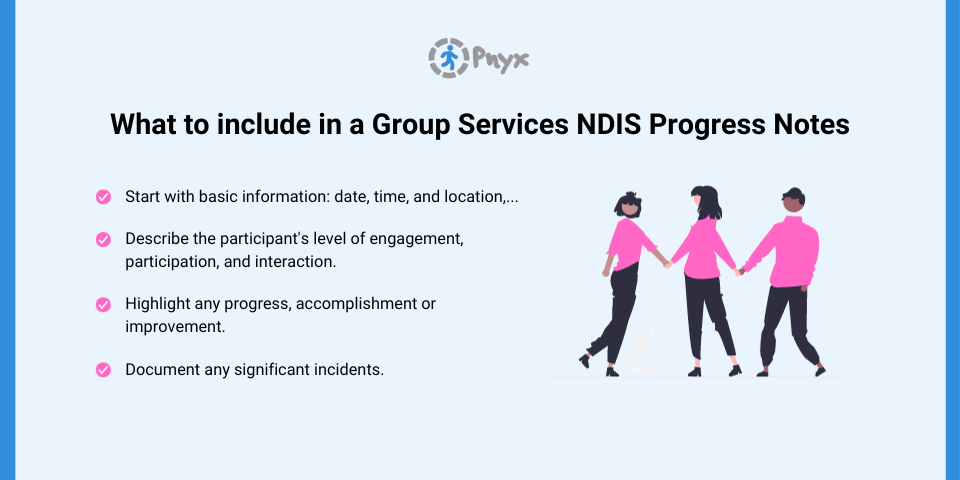
- Start with Basic Information: Service providers can start writing each progress note with the date, time, location, and duration of the group session. Besides, service providers should mention the nature of the session, the activities conducted, and the staff involved.
- Describe the Participant's Experience: Document the participant's level of engagement, participation, and interaction within the group. Additionally, service providers can capture their behaviour and mood.
- Highlight Progress: Document any progress, accomplishment or improvement that the participant makes in a group session, and how this progress contributes towards their NDIS goals.
- Incidents Report: It's also crucial to document any significant incidents (including alleged incidents) involving the participant during the group session.
2. Personal Services NDIS Progress Notes
Guidelines
- Detail-Oriented: The NDIS progress notes for personal services should be detailed and specific, capturing the individual's progress and response during the session.
- Regular Update: Regularly update the progress notes after each session to maintain an accurate record of the participant's progress and changes in their condition.
- Clear Objectives: Each note should show how the service given is helping the participant one step closer to achieving their NDIS goals.
What to Include
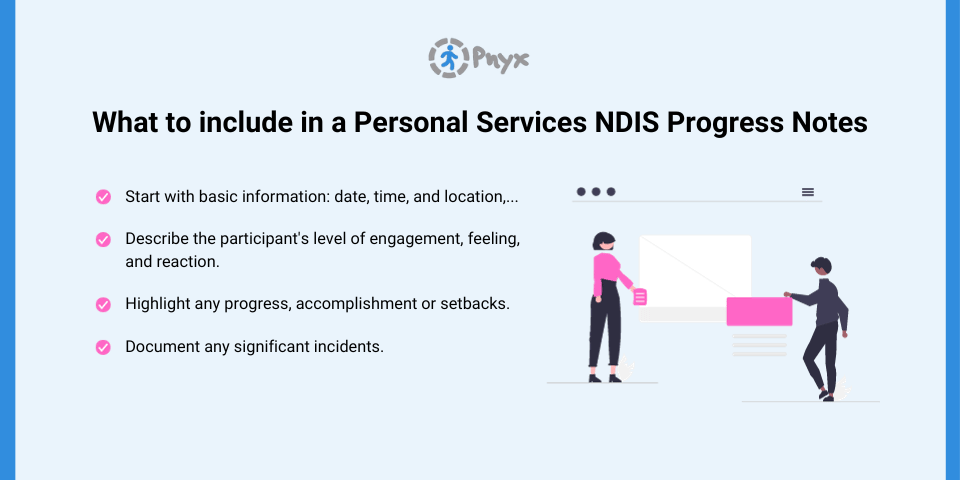
- Basic Details: Start the progress notes by documenting the date, time, location, service duration, the specific type of service provided, and the staff involved.
- Detail the Participant's Response: Clearly note what the participant did and said, how they felt, and how they reacted during the service.
- Connect to NDIS Goals: Clearly document how the service provided is helping the participant one step closer to achieving their NDIS goals. Besides, service providers can outline any progress or setbacks in their journey towards these goals based on the session.
- Incidents Report: It's also crucial to document any significant incidents (including alleged incidents) involving the participant during the group session.
3. Transport Services NDIS Progress Notes
Guidelines
- Journey-Focused: Unlike other services, the emphasis of NDIS progress notes for transport service is on the overall experience of the participant during their travels.
- Transparency: It's essential to maintain clear, transparent records for billing purposes, especially since transport services can involve various costs, such as tolls or fuel.
- Participant Experience: NIDS providers should note participants' expressed concerns or satisfaction, and how they accommodated specific needs during the journey.
What to Include
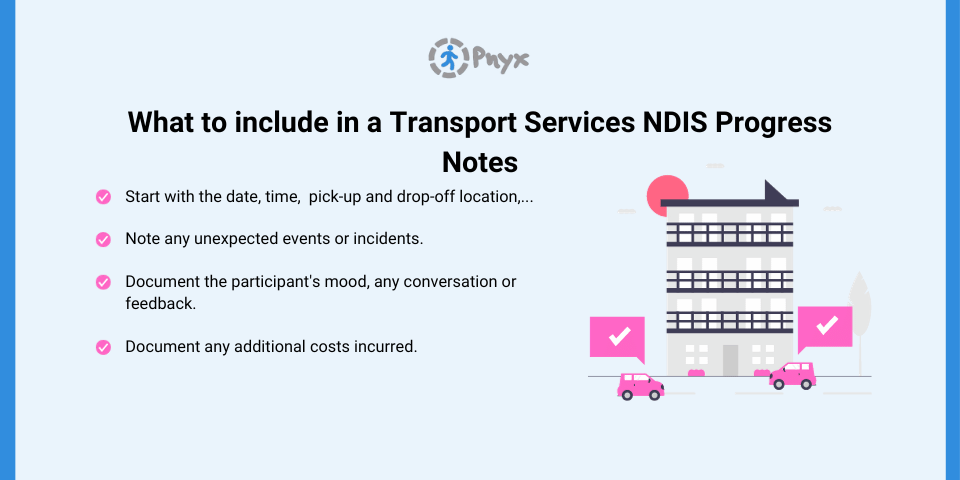
- Basic Journey Details: Each progress note should start with the date, time, pick-up location, drop-off location, duration of the journey, the staff involved and the vehicle used.
- Travel Conditions: Note any unexpected events or incidents during the journey, such as traffic delays, or weather issues, and how these events were managed to ensure the participant's comfort and safety.
- Participant's Interaction: Document the participant's mood, any conversation or feedback they gave, and general behaviour.
- Expenses Incurred: If applicable, progress notes should include any additional costs incurred during the journey, such as parking or tolls which are agreed upon with the participant or their plan manager.
4. Short-term Accommodation NDIS Progress Notes
Guidelines
- Participant-Centreed Care: Given the temporary nature of STA, it's vital to document how the participant adapts to the new environment, such as their daily activities, interactions, and any changes in their usual behaviour or routine.
- Continuity of Care: As STA serves as a temporary change from the participant's usual setting, it's crucial to document any new behaviours, preferences, or needs identified during the stay.
What to Include
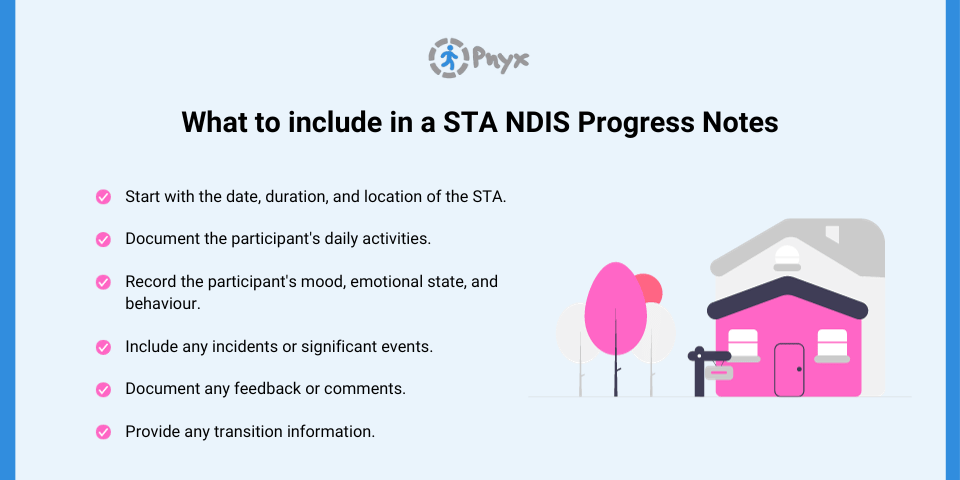
- Basic Stay Details: Start with the date, duration, and location of the STA. Besides, service providers can note the reason for the stay, such as respite for caregivers, or trial of a new setting, and the staff involved in the participant's care.
- Daily Activities and Routine: Document the participant's daily activities, including personal care routines, meals, social interactions, and any changes in their typical routine.
- Participant's Behavior and Mood: Record the participant's mood, emotional state, and behaviour. Service providers also need to pay attention to any signs of anxiety, happiness, discomfort, or unusual behaviours and how staff respond to these.
- Incidents or Significant Events: Include any incidents or significant events that occurred during the stay, how they were managed, as well as their impact on the participant's future care or support needs.
- Feedback from Participant: If possible, document any feedback or comments provided by the participant regarding their stay.
- Transition Information: Provide any necessary information that will assist with the participant's transition back to their regular environment. This could include recommendations for changes to routines, new supports needed, or strategies that were particularly effective during the STA.
Frequently Asked Questions
What are the key components of effective NDIS progress notes?
Effective NDIS progress notes should be clear, detailed, and linked to the participant’s NDIS goals. Each note should include the date, time, location, duration of the service, and describe what support was provided, how the participant responded, and any relevant changes or incidents. Notes should be written in active voice, free from jargon, and maintain a professional and factual tone to support quality care and auditing requirements.
How can I ensure my NDIS progress notes are person-centred?
To make progress notes person-centred, focus on the individual’s experiences, preferences, and goals rather than just listing tasks completed. Use the participant’s name, document their emotions, feedback, and behaviours, and describe how the support provided is helping them progress towards their NDIS goals. Avoid generalisations and make sure the note reflects the unique context of each participant’s journey.
What tools or features can help streamline NDIS progress note documentation?
Care management software like Comm.care simplifies progress note documentation with features such as real-time note-taking, customisable templates, and centralised timelines. With mobile access, staff can document at the point of care, improving accuracy and efficiency. Features like automated compliance tracking, team communication feeds, and secure document storage also ensure your organisation remains audit-ready and focused on person-centred care.